As AI agents, copilots, and recommendation systems increasingly mediate discovery and decision-making, modern marketing must evolve from human persuasion to machine readability. This post explores why the next winners in Martech and GTM will be the companies that build structured, trustworthy, machine-readable growth infrastructure.
For most of modern marketing, we made one core assumption without even saying it out loud: the audience was a person.
A buyer saw the ad. A prospect opened the email. A decision-maker compared vendors. A customer clicked the message. Even when the buying journey became more digital, it was still framed around human attention, human interpretation, and human action.
That assumption is now breaking.
Not because humans are disappearing. They are not. But because they are no longer the only layer that matters. Between the brand and the buyer, a new decision layer is emerging: AI agents, copilots, recommendation systems, ranking algorithms, and large language models that increasingly mediate discovery, evaluation, and action. In many cases, the first “reader” of your message is no longer a person. It is a machine deciding whether you are worth showing, summarizing, recommending, or triggering at all.
That changes marketing more than most teams realize.
AI Limits Message Visibility and Action
What’s Actually Changing
When I say machines are now part of the audience, I do not mean some abstract future where robots are buying software from other robots.
I mean something much more immediate.
An executive asks an LLM which vendors are best for warehouse-native customer engagement. A procurement workflow uses AI to summarize vendor responses before a human reads them. A sales rep’s copilot suggests which platform to shortlist based on integration depth, implementation risk, and ecosystem fit. A recommendation engine determines which products deserve visibility. A search engine answers the question directly, without sending the user to your site. A customer support agent decides which offer, article, or next-best action to surface before the customer ever sees a menu.
In each case, the machine is not the final economic buyer. But it is shaping the path to selection. It is filtering the field. Compressing options. Translating complexity. Deciding what becomes legible.
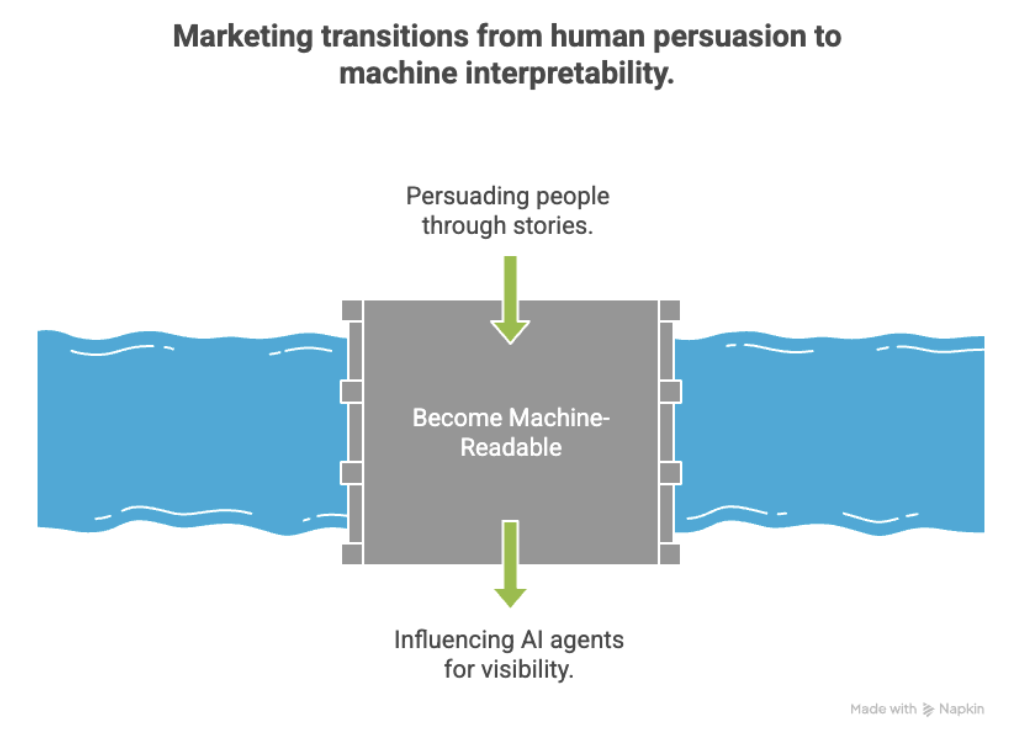
Traditional marketing was built to persuade people. This next era requires companies to become interpretable by systems.
That is a different discipline.
A human can tolerate ambiguity, branding theater, and a well-told story. A machine cannot do much with vague positioning, fragmented data, or buried product truth. Humans can infer. Machines need structure. Humans can be won through narrative. Machines privilege signals.
This is why so much of the stack is about to be revalued.
Marketing transitions from human persuasion to machine interpretability
The biggest mistake leaders can make is to treat this as a messaging problem. It is not. It is an infrastructure problem.
If machines are participating in discovery and decisioning, then Martech has to evolve from a campaign system into a machine-readable growth system.
That starts with the data model.
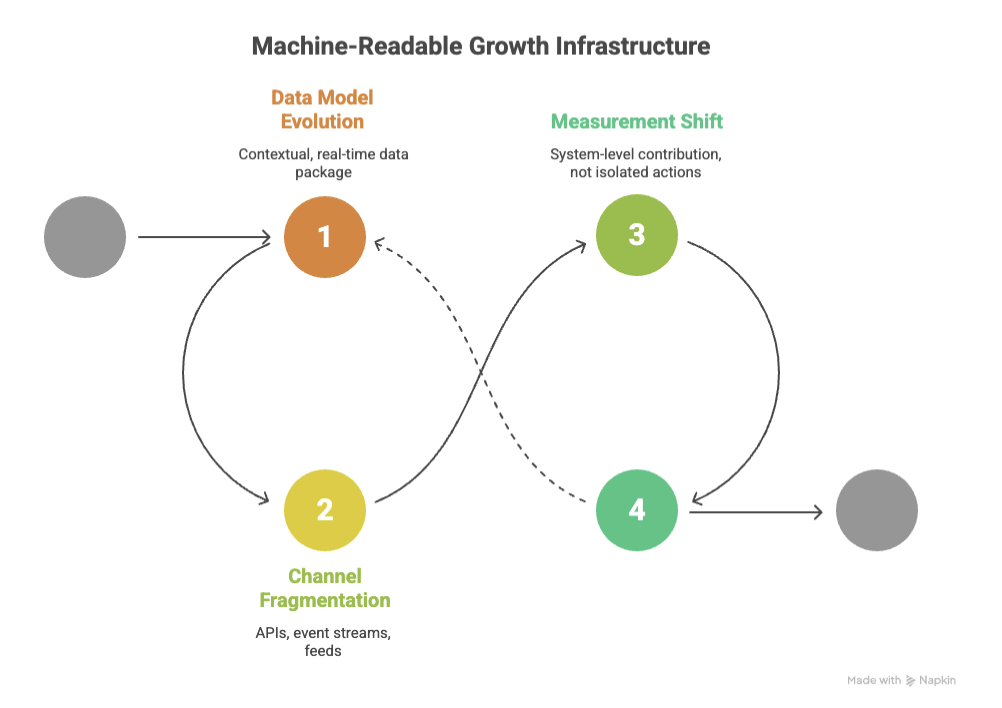
For years, customer data platforms and engagement tools centered on the idea of a profile: attributes, events, segments, journeys. That model still matters, but it is no longer sufficient on its own. The new requirement is context that can be read, scored, and acted on by both humans and machines in real time.
A customer record is no longer just a person with traits. It is a dynamic package of intent, eligibility, product usage, commercial value, consent status, propensity, and relevance. It has to be structured in a way that downstream systems can use without manual interpretation. That means cleaner schemas, stronger identity resolution, better event discipline, and much tighter alignment between warehouse, activation, and execution layers. The momentum behind composable CDPs and reverse ETL is not accidental. It reflects a market that is moving closer to the data source because that is where machine-readable truth lives.
Personalization changes too.
The old model of personalization was mostly about customizing messages for human consumption: first name, product recommendation, send time, channel preference. Useful, but limited. The next model is about optimizing signals for machine consumption as well. Is your product catalog structured clearly enough for an agent to retrieve the right answer? Is your offer logic exposed in a way a decision engine can evaluate? Are your product capabilities represented consistently enough that an LLM can summarize you accurately? Are your knowledge assets structured so a copilot can recommend you with confidence?
That is personalization at a different layer. Less “what subject line should this user see?” and more “what truth can this system reliably act on?”
Channels will fragment along the same fault line.
Email, SMS, push, and in-app are not going away. But they will increasingly sit downstream of decision systems rather than upstream of campaign planning. The strategic channels of the next few years are not just communication surfaces. They are APIs, event streams, structured feeds, embeddings, knowledge layers, and the interfaces through which machines gather and act on information.
In other words, distribution becomes dual-path: one path for humans, one path for machines.
Measurement gets harder as a result.
When discovery happens inside an AI answer, or evaluation is compressed by an agent before a seller ever gets a meeting, attribution becomes less visible. Teams will know influence occurred, but they will not always see the old clickstream that proved it. The signal chain becomes more opaque. That does not mean measurement dies. It means the model shifts from tracking isolated human actions to instrumenting system-level contribution across data creation, retrieval, ranking, recommendation, and conversion. The teams that win will measure not just engagement, but availability to decision systems.
This is what I mean by machine-readable growth infrastructure: the combination of structured data, real-time context, accessible logic, and interoperable systems that makes a company easy for machines to evaluate and activate.
That will matter more than another campaign workflow builder.
Machine-Readable Growth Infrastructure
Winners and Losers
Every major platform shift creates a redistribution of value. This one will be no different.
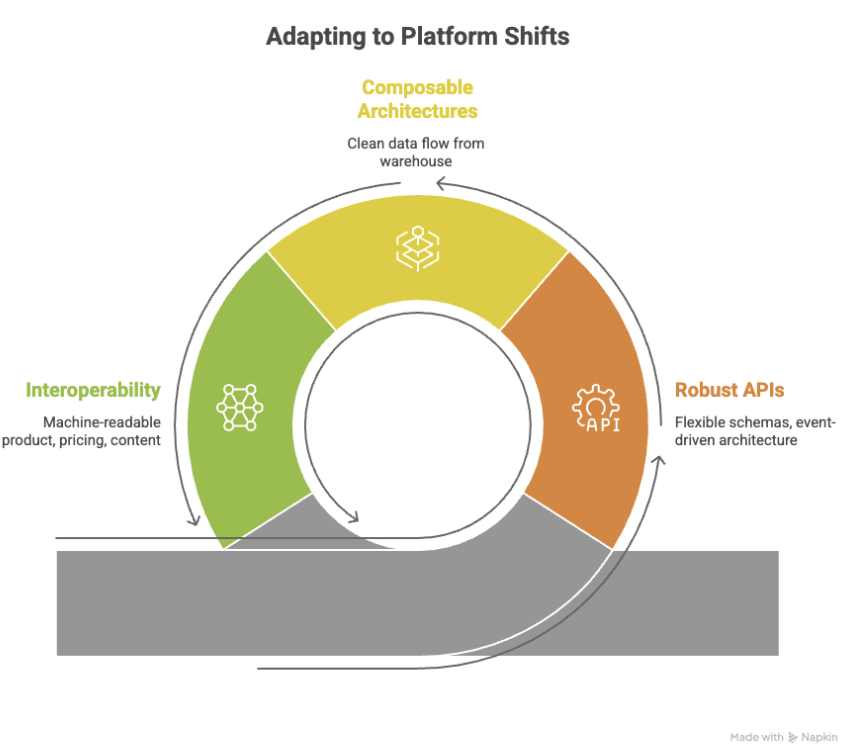
The winners will be companies with strong data foundations. Teams that already treat the warehouse as a source of truth. Platforms built with robust APIs, flexible schemas, event-driven architecture, and real-time decisioning. Vendors that can participate inside the decision layer rather than just deliver the message after the decision has already been made.
Composable architectures should do well here for a simple reason: they reduce the distance between truth and action. If your stack allows data to move cleanly from warehouse to model to audience to channel, you are better positioned for a world where machine systems need immediate access to reliable context.
The winners will also include companies that understand retrieval, structure, and interoperability. Not just brand awareness. Not just creative. They will care about how their product, pricing, content, and proof points are represented in forms machines can use.
The losers will be more exposed than they think.
Channel-centric tools that mistake delivery for strategy. UI-heavy platforms that look polished but sit on brittle data models. Vendors that still rely on manual exports, delayed syncs, and fragmented customer context. Companies whose product truth is trapped in decks, PDFs, or a salesperson’s head. Tools that only perform when a human operator is there to translate, reconcile, and push the button.
There will also be a subtler loser: companies built around renting human attention instead of integrating with the systems that shape decisions. In a zero-click environment, visibility without machine legibility becomes a diminishing asset.
Adapting to Platform Shifts
What This Means for GTM Teams
This is not just a Martech story. It is a GTM operating model story.
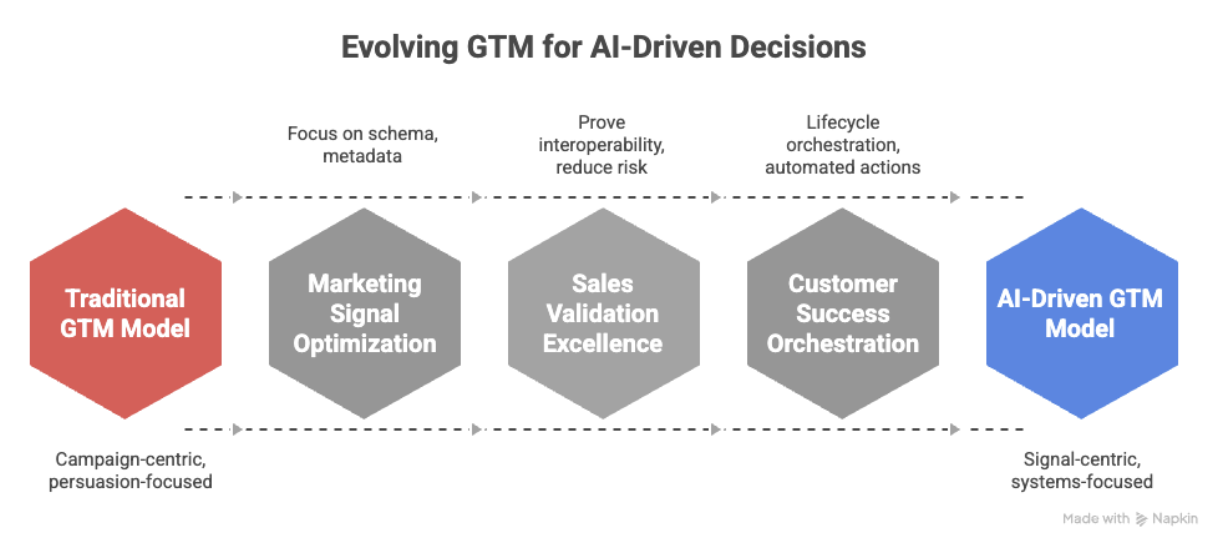
Marketing has to move from campaign production toward signal optimization.
That does not mean campaigns disappear. It means the center of gravity changes. The best marketing teams will think more like system designers. They will care about schema quality, metadata, retrieval surfaces, content structure, and feedback loops. Their job will not just be generating demand. It will be increasing the probability that the right decision layer can find, trust, and act on the right context at the right time.
Sales changes too.
The historical sales advantage came from controlling information, shaping perception, and managing the process. But when buyers arrive with machine-assisted shortlists and synthesized vendor comparisons, persuasion alone becomes less valuable. Sales teams will need to excel at validation. They will need to prove interoperability, reduce execution risk, clarify tradeoffs, and help both human buyers and internal decision systems understand why the choice is safe and superior.
That is a different kind of seller. More commercial architect than pure persuader.
Customer Success also evolves.
The old model emphasized relationships, check-ins, and reactive support. The new model requires lifecycle orchestration across human and machine touchpoints. Success teams will need to ensure that product usage data, health signals, expansion triggers, and support context are all flowing into systems that can drive the right next action automatically. This becomes less about “owning the relationship” and more about ensuring the customer system is continuously legible and actionable.
Across all three functions, new capabilities become non-negotiable: data fluency, systems thinking, comfort with AI-mediated journeys, and a much stronger understanding of how GTM actually works at the infrastructure layer.
The next generation of commercial leaders will not just ask, “What message are we sending?”
They will ask, “What signals are we emitting, where are they flowing, and which systems are acting on them?”
Evolving GTM for AI-Driven Decisions
The Stack Three to Five Years From Now
In three to five years, I expect the center of the GTM stack to look different.
The warehouse or operational data cloud becomes more central. Identity, event collection, and governed context sit closer to that core. Activation layers become thinner, faster, and more composable. Decisioning becomes more distributed across models, agents, and business logic systems. Channels become execution endpoints, not the intelligence layer. And the most valuable platforms are the ones that can connect context, decisioning, and action without forcing teams into monolithic workflows.
Put differently: the winners will not be the tools that help you send more messages. They will be the systems that help the right decisions happen.
So what should leaders do now?
First, audit your machine readability. Not your website copy. Not your brand campaign. Your actual machine readability. Can your product, proof points, policies, catalog, customer data, and lifecycle signals be consumed reliably by systems?
Second, tighten the gap between warehouse and activation. The farther your execution layer is from your source of truth, the more fragile your decisioning becomes.
Third, invest in structured knowledge. If your differentiation only exists in narrative form, you are already behind.
Fourth, redesign GTM metrics to account for invisible influence. The old click path will not capture enough.
Fifth, train teams to think in systems, not silos. The machine-mediated journey does not care how your org chart is drawn.
Closing
The next wave of growth will not go to the companies with the loudest message.
It will go to the companies that are easiest for both humans and machines to trust, understand, and act on.
Because the audience is no longer just humans.
And the teams that recognize that early will not just market better. They will build the infrastructure that gets chosen before the rest of the market realizes the rules changed.
Building an ad tech sales team from scratch is one of the most critical, yet often overlooked skills of a great CRO or sales leader. Early decisions around team structure, market focus, candidate profiles, etc. create the company’s growth ceiling. Get it right, and the team can take off like a rocket - get it wrong, and the rocket will sputter.
If your company's new Adtech or Martech product isn't lighting the world on fire like you hoped it would, don't be took quick to blame your sales team. The problem may be that your GTM process sucks.
Seamless handoffs between sales, onboarding, and customer success are critical to delivering a consistent customer experience and unlocking long-term growth. This post explores where friction typically occurs and outlines actionable strategies to drive retention through structured transitions, shared accountability, and early customer value.






.png)

